Princeton, TX
RV roof and seal repair
RepairAnyRV reseals, repairs, and replaces RV roofs at our shop in Princeton, TX. We look at the roof first, tell you which of the three jobs it needs, and quote it before any work starts.
Why the sealant matters
The sealant on your roof is the cheapest thing on the trailer, and it decides how long you own it.
Every hole in an RV roof is closed with a bead of sealant. Vents, fans, skylights, antennas, solar mounts, the seams at the front and rear caps, and every screw that goes through any of it. New sealant is flexible. Old sealant chalks, cracks, and lets go, and the day it lets go is not the day you find out.
Keep the water out and a trailer lasts. Let it in and you stop paying for sealant and start paying for wood.
The Visit
What we look at
A roof visit is not a fresh bead over the old one.
- Every penetration. Vents, fans, skylights, the AC shroud, antennas, plumbing vents, solar mounts, and every screw head.
- The caps. The front and rear cap seams, where the roof, the cap, and the sidewall meet and the joint moves every time you tow.
- The edges. Both drip rails and the corner trim down each side.
- The membrane. Punctures, seam separation, and whether it is still bonded to the decking.
- The decking under it. A roof that gives underfoot has already taken water, and sealant does not fix that.
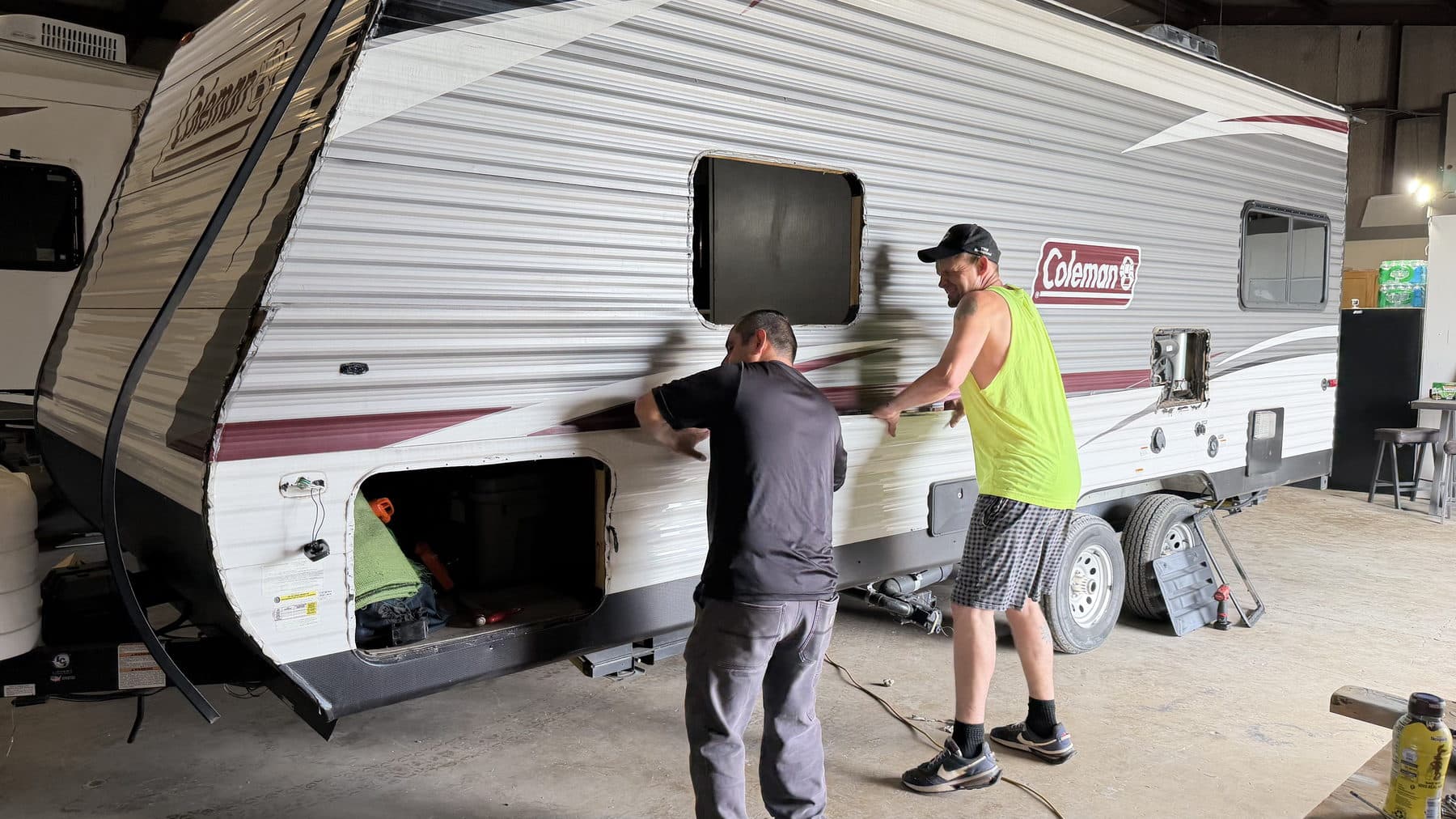
- The seams that are not on the roof. Sidewall caulking, windows, doors, baggage doors, marker lights, the awning rail, and slide-out toppers and seals. They leak the same way, so they get looked at in the same visit.
Three Different Jobs
Reseal, repair, or replace
The point of looking first is knowing which one you are in.
Reseal. The membrane is sound, the decking is solid, and the sealant has aged out. We remove what has failed, prep the surface, and reseal.
Repair. The membrane is torn, punctured, or separated at a seam, or a section of decking has gone soft. We open up the affected area, fix what has to come out, patch the membrane, and reseal. Bigger than a reseal, far smaller than a replacement.
Replace. The membrane is at the end of its life, or water has been getting in long enough that the decking is gone across a broad area. Then the roof is stripped, the decking is replaced as needed, and a new membrane goes on.
We tell you which of the three it is before we start, and we quote it before we start. No surprise bills at pickup.
The Shop
Who does the work
Roof sealant and caulking is a shop specialty, and the shop is the same one that does the water damage repair afterward, so nobody is guessing about what a roof problem turned into.
We service travel trailers, 5th wheels, and park models, plus the coach living systems on motorhomes. We do not service engines, drivetrains, or generators.
Maintenance
How often to check it
Look at your sealant twice a year and after anything that hits it, and plan to reseal on a schedule instead of waiting for a leak. The right interval depends on the roof material and on whether the trailer lives under cover, so we would rather look at yours and tell you than publish a number that is wrong for your unit. Sun, more than rain, is what breaks sealant down, so a trailer that sits outside in North Texas takes it harder than one kept under a roof.
Past the Roof
When it has already gotten in
Sometimes the roof is not the only question anymore.
A stain in a ceiling corner, a soft spot in the floor, a wavy sidewall, or a musty smell means water has been inside for a while, and the roof is only where it came from. The sealant still has to be fixed, and so does whatever it damaged on the way down. That is a different visit: a water damage inspection, where we find out how far it went before we quote the repair. Sealing a roof over rot only hides it.
Questions
Roof and seal repair questions
- How often does an RV roof need to be resealed?
- Inspect the sealant at least twice a year and after any impact, and reseal on a schedule rather than waiting for a leak. The interval depends on the roof material and whether the trailer is kept under cover. Sun is what breaks sealant down, so a trailer that lives outside in Texas needs it sooner than one that lives in a barn.
- Can a leaking RV roof be repaired, or does it have to be replaced?
- Usually it can be repaired. If the membrane is sound and the decking under it is solid, it is a reseal. A tear or one soft section is a patch and a partial decking repair. Full replacement is for a membrane at the end of its life or decking that has gone soft across a broad area. Which one you need is decided by walking the roof and checking the decking, not by the age of the trailer.
- What does an RV roof inspection include?
- Every roof penetration, the front and rear cap seams, both drip rails, and the membrane, plus the decking under it. We also check the seams that are not on the roof, including windows, doors, baggage doors, marker lights, the awning rail, and slide-out seals, because those leak the same way.
- Will I get a quote before you start?
- Yes. We diagnose, quote, and wait for your go-ahead. No payment is taken when you book.
More answers on the RV repair questions page.
Bring It In
Bring the roof in
Tell us what you are seeing and add a photo if you have one. We look at it, tell you which of the three jobs it is, and quote it before anything happens.
2745 FM 1377, Princeton, TX 75407
Monday to Friday, 9 to 2, and by appointment.